
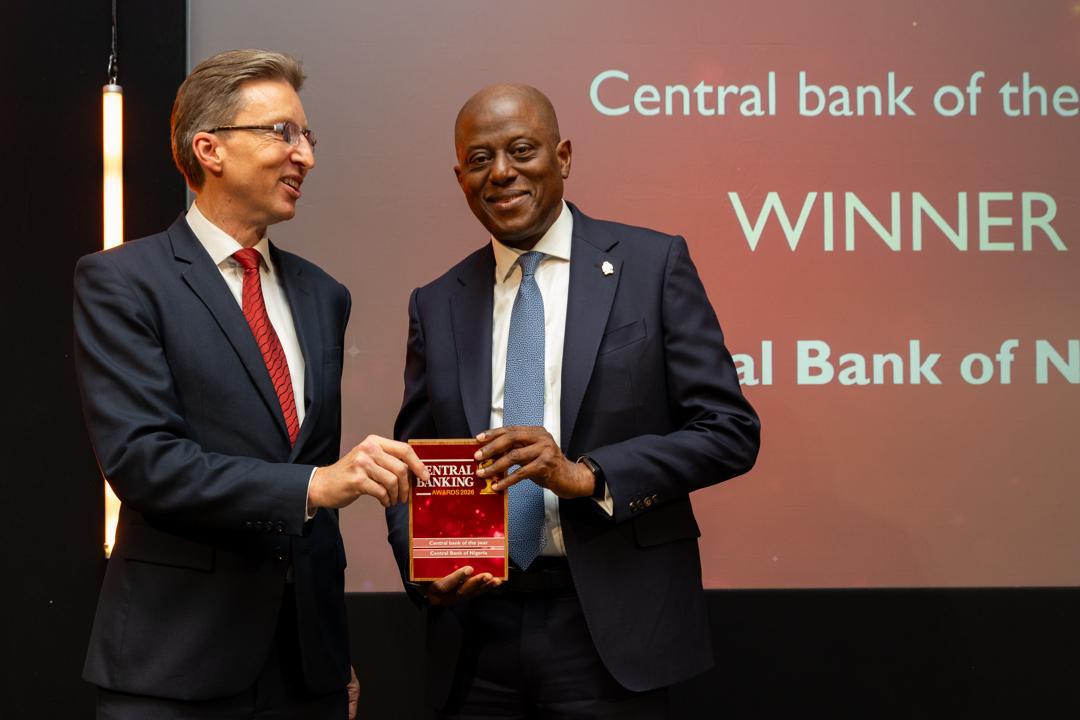
The Central Bank of Nigeria’s (CBN) sweeping reforms under Governor Yemi Cardoso reached a new pinnacle of global recognition on 10 June 2026, when the institution was named Central Bank of the Year at the prestigious Central Banking Awards in London.
Accepting the award on behalf of the Bank, Cardoso anchored his remarks on humility and responsibility. “We receive this recognition with humility. We see it, not as a destination, but as encouragement to continue the important work ahead,” he said.
For observers of Nigeria’s economic trajectory, the honour marks a dramatic turnaround for an institution that, only a few years earlier, was grappling with severe macroeconomic distortions. The CBN’s transformation driven by a disciplined return to autonomy, transparency, and orthodox monetary policy has become a case study in institutional rehabilitation.
A Reform Programme That Rebuilt Credibility
Cardoso’s acceptance speech also underscored the collective effort behind the reforms. “I accept this award on behalf of the Board, Management and staff of the CBN. Above all, it belongs to the many dedicated professionals who serve our institution with integrity, expertise, and an unwavering commitment to the public good,” he noted.
He also reflected on the gravity of the institution’s mandate: “The responsibility entrusted to central banks is a solemn one – to preserve confidence, safeguards to stability and to create the conditions in which economies and societies can prosper.”
Those responsibilities were tested in 2023, when the CBN confronted a challenging macroeconomic landscape: high inflation, depleted reserves, a widening FX spread, a backlog of over $7 billion in matured FX obligations, and a breakdown in monetary policy credibility.
In three years, the Bank implemented a suite of reforms that have reshaped Nigeria’s macroeconomic fundamentals:Inflation moderated to about 15% under a strengthened inflation‑targeting regime, Foreign reserves rose above $50 billion, providing more than ten months of import cover, The FX market stabilised, with the spread between official and parallel markets narrowing from 60% to about 2%, The banking sector recapitalisation programme strengthened resilience and investor confidence, while Nigeria exited the Financial Action Task Force (FATF) grey list, signalling improved compliance and transparency.
These achievements formed the basis of the global recognition.
Why Central Banking Honoured the CBN
Christopher Jeffrey, editor‑in‑chief of Central Banking, said the award reflected the scale and impact of the reforms. The CBN was recognised for “its monetary policy reforms that overturned past frameworks and resulted in widespread improvements in the country’s economy.”
He added that the reforms enabled the Bank to “implement disciplined monetary tightening, while also pursuing FX market reform. A further major achievement has been the CBN’s clearance of more than $7bn of outstanding obligations.”
The publication also highlighted governance and transparency improvements, payments modernisation, banking sector recapitalisation, and Nigeria’s removal from the FATF grey list as evidence of a comprehensive institutional overhaul that rebuilt public and investor confidence.
Broader International Recognition
The CBN’s reform momentum has drawn praise from multiple quarters. The International Monetary Fund noted that its “Directors welcome steps by the authorities to build reserves and support market confidence and praised reforms to the foreign exchange market that supported price discovery and liquidity.”
In 2025, Cardoso was named Central Banker of the Year at the African Banker Awards, where organisers cited the Bank’s “critical role in addressing market imbalances and repositioning the Nigerian economy for sustainable growth.”
Domestically, the Centre for Economic Growth and Monetary Reforms (CEGMR) commended the Bank’s discipline, stating: “Monetary policy is not magic, but discipline pays off. The CBN’s commitment to consistency and orthodox tools is now reflected in falling inflation, stabilising exchange rates, and a rebound in external reserves.”
Reforms Continue: Strengthening the Financial System
Even as global accolades accumulate, Cardoso has emphasised that the reform journey is far from over. On the day of the award ceremony, the CBN released new draft guidelines for the licensing and regulation of financial holding companies (FHCs/HoldCos), aimed at strengthening governance, capital adequacy, and operational ring‑fencing across financial conglomerates.
The proposals, including a requirement for HoldCos to maintain a minimum 51% equity stake in each subsidiary, are designed to “enhance the stability of the banking sector and protect depositors’ funds.”
The Bank is also tightening implementation of its FX manual to deepen transparency, broaden market participation, and strengthen documentation and surveillance standards.
More Work Ahead
If the award symbolises a milestone, Cardoso views it as a mandate for deeper consolidation. The CBN’s reforms have restored credibility, stabilised markets, and repositioned Nigeria as a serious player in global finance. Yet, as he reminded the audience in London, the task of safeguarding stability is continuous.